Some names sound like they belong in Scripture, yet you will not find them on any page. The Tristan name meaning is a perfect example. It feels ancient, noble, and a little mysterious, so people assume the Bible holds the answer. This guide gives you the honest story, plus the real spiritual lessons behind it.
Here is what you will learn. We trace the Tristan name meaning from Celtic Britain to medieval France. We check Hebrew, Greek, and Scripture for any link. Then we look at the faith themes that make this name meaningful to Christian families. By the end, you will know what is fact, what is tradition, and what is internet myth.
Tristan Meaning in Bible–More Than Just a Name
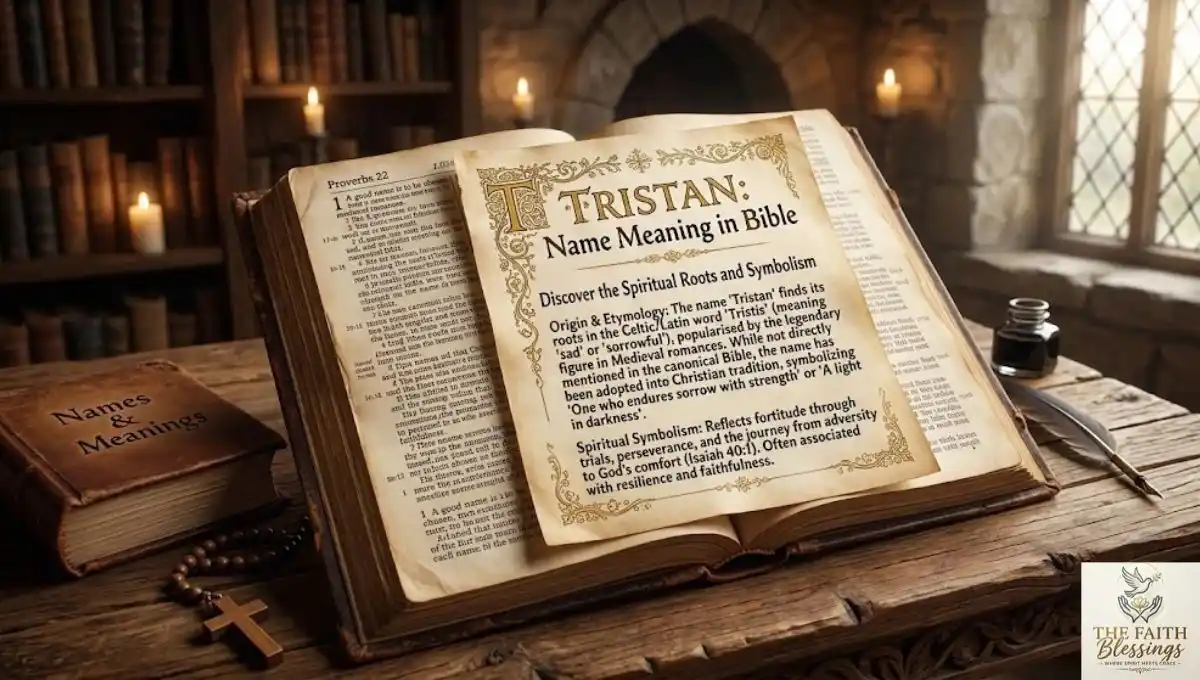
Let’s settle the big question first. Tristan is not a biblical name. No person in the Old or New Testament carries it.
Still, the Tristan name meaning connects with themes Scripture covers deeply: sorrow, endurance, and restored joy. That is why many believers feel drawn to it.
Think of it as a name with Christian echoes, not Christian roots. That difference matters, and we will keep it clear throughout.
Tristan Name Meaning Bible
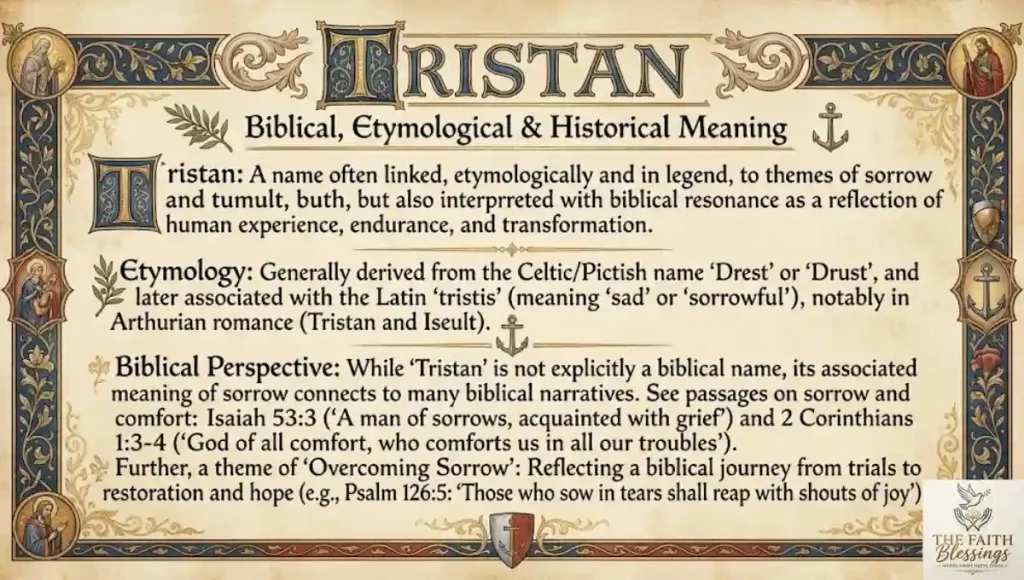
Searches for the Tristan name meaning Bible readers want usually turn up two camps. One says Tristan appears in Scripture. The other says it has no spiritual value at all. Both miss the mark.
The name is absent from the Hebrew Bible, the Septuagint, and the Greek New Testament. Yet it has lived inside Christian culture for nearly a thousand years. Here is a quick snapshot.
| Feature | Detail |
| Language of origin | Brittonic (Celtic), reshaped by Old French |
| Early forms | Drust, Drustan, Drystan |
| Common meanings | Tumult or uproar; sad or sorrowful |
| Found in the Bible? | No |
| Best-known source | The medieval legend of Tristan and Iseult |
| Usual gender | Male |
Use your left or right arrow keys or drag and drop with the mouse to change the gradient position. Press the button to change the color or remove the control point.
What Does the Name Tristan Mean?
Two meanings compete. The older one is Celtic and points to noise, tumult, or uproar. The later one comes through French and Latin and means sad or sorrowful.
Most baby name sites lead with “sorrowful.” That version is a product of medieval wordplay, and it is the one most people have in mind when they ask about the Tristan name meaning.
Etymology and Historical Origins of Tristan
The trail starts in early Britain. Here is how the name evolved.
- Brittonic roots: The Welsh word drust means “tumult” or “noise.” Early forms such as Drust and Drustan come from it.
- Cornwall: A 6th-century granite pillar known as the Tristan Stone carries the inscription Drustanus. It is one of the oldest physical links to the name.
- Old French: Twelfth-century poets spelled it Tristan and Tristran.
- Latin influence: The Latin tristis (“sad”) and French triste nudged the meaning toward sorrow.
So the sorrowful sense is a literary layer, not the original one. That nuance rarely appears in quick name lists.
Also Read : What Does “Arlo Mean in Bible”?
Is Tristan Mentioned in the Bible?

No. Not once. You can check this yourself in any concordance.
Some websites claim a biblical Tristan or say the name means “of the sea” in Hebrew. Those claims have no manuscript support. Reliable research on the Tristan name meaning starts with primary sources, not recycled blog posts.
Here is a simple way to verify any “biblical name” claim:
- Search a trusted concordance for the exact spelling.
- Check the Hebrew, Aramaic, or Greek original.
- Look for a named person, not just a similar sound.
- Be wary of sites that give no citations.
Spiritual Significance of the Name Tristan
A name does not need to be in Scripture to carry spiritual weight. Many Christian parents choose names for the values they hope to see in a child. The sorrowful meaning may sound heavy, but the Bible never treats sorrow as the end of the story.
Christian Symbolism and Faith Connections
The Tristan name meaning pairs well with several passages about pain and hope. These are interpretive links, not claims that the verses are about the name.
- Psalm 30:5: Weeping may last for a night, but joy comes in the morning.
- John 16:20: Jesus tells his disciples their grief will turn into joy.
- Isaiah 53:3: The coming Messiah is described as a man of sorrows.
- Romans 5:3-4: Suffering produces endurance, and endurance produces character.
Read together, they offer a hopeful frame. Sorrow is real, but it can lead to strength and renewal.
Tristan in Biblical History and Tradition

Tristan has no place in biblical history. His home is Christian tradition. The medieval Tristan legend was written inside a Christian world, so its themes of guilt, loyalty, and suffering carried religious overtones.
Medieval readers also loved allegory. They often read stories the way they read Scripture, looking for deeper moral layers. A related name, Drostan, belongs to an early Scottish saint, which shows how this name family entered church life.
The Origin of Tristan in Celtic and Christian Culture
The legend itself is Celtic at heart. It grew around Cornwall, Wales, and Brittany, then spread across Europe through French and German poets. Richard Wagner’s 1865 opera helped cement its fame.
Over time, Christian Europe adopted the name freely. Today the Tristan name meaning blends two worlds: Celtic tumult and Christian reflection on sorrow. Neither world is found in the pages of the Bible, yet both shaped how believers received the name.
Biblical Names Similar to Tristan
No biblical name sounds exactly like Tristan. Some, however, share its emotional meaning or a similar sound. This table compares them.
| Name | Meaning | Where it appears | Link to Tristan |
| Ben-oni | “Son of my sorrow” | Genesis 35:18 | Same sorrow theme |
| Mara | “Bitter” | Ruth 1:20 | Grief that later turns to joy |
| Jabez | Linked to pain | 1 Chronicles 4:9 | Pain met with blessing |
| Timothy | “Honoring God” | Acts 16 | Similar sound |
| Titus | Uncertain meaning | Titus 1:4 | Similar sound |
Ben-oni is the closest match. His father renamed him Benjamin, which turned a name of sorrow into a name of strength. That small story mirrors the best reading of the Tristan name meaning.
Why Parents Choose Tristan: A Biblical Perspective
Parents rarely choose a name for one reason. Here are the most common ones among faith-minded families.
- The sound is strong and classic.
- The Tristan name meaning suggests depth and resilience.
- It reminds them that God redeems hard seasons.
- It carries a heroic, loyal image from legend.
- It feels distinctive without being hard to spell.
Some parents also treat it as a quiet prayer. They hope their son will face struggle with faith and come through it with hope.
Tristan Name Meaning in Hebrew
Tristan has no Hebrew origin. It never appears in the Hebrew Bible, and no Hebrew root produces it. Claims that it means “of the sea” or “triumphant” in Hebrew are unsupported.
You can still explore the Tristan name meaning through Hebrew concepts. Yagon means sorrow, etzev means pain, and tikvah means hope. Scripture often moves from the first two toward the third. That is a thoughtful comparison, but it is a spiritual lens, not a translation.
Tristan Name Meaning in Greek
Greek is not the source either. The “sad” meaning comes from Latin tristis. The Greek New Testament uses the word lypē for sorrow or grief, which appears in John 16:20.
So the Tristan name meaning in Greek is best described as a conceptual parallel. The idea of grief turning to joy is Greek-language Scripture. The word Tristan is not.
The Cultural and Religious Impact of the Name Tristan
Few names have traveled so far from a single story. Tristan has appeared in medieval poetry, opera, novels, and film. Each retelling reinforces the image of a loyal, passionate, and sometimes tragic figure.
In religious settings, the name is accepted without controversy. Churches do not treat it as pagan or problematic. Many pastors see the Tristan name meaning as a teaching opportunity about suffering and hope.
What the Bible Teaches About Names and Identity
Biblical names often reflect character, circumstance, or calling. Abram became Abraham in Genesis 17:5. Jacob became Israel in Genesis 32:28. Revelation 2:17 even promises a new name to those who overcome.
But the Bible never says a name controls destiny. Ben-oni’s name meant sorrow, yet he became Benjamin, a tribe’s namesake. The lesson is simple. Identity is shaped by God and by choices, not just by a dictionary definition. That applies to the Tristan name meaning too.
Biblical Interpretations in Dreams or Real Life
Some people ask what it means to see the name Tristan in a dream or to meet someone with that name at a turning point. Scripture gives no code for this.
Here is a grounded approach:
- Treat it as personal reflection, not prophecy.
- Compare any impression with Scripture, as 1 Thessalonians 5:21 advises.
- Talk with a pastor or trusted mentor.
- Avoid building major decisions on a name’s symbolism alone.
If the Tristan name meaning stirs something real in you, let it prompt prayer, not superstition.
Practical Lessons and Faith Insights
Even without a verse, the Tristan name meaning offers useful takeaways:
- Honesty matters. Say clearly that the name is not in the Bible.
- Origins tell the truth. Celtic and Latin roots are enough to make it interesting.
- Sorrow is not final. Scripture consistently moves from grief to hope.
- Meaning is chosen. Families can give a name spiritual purpose through how they raise a child.
- Check your sources. Many “biblical meaning” pages repeat each other without evidence.
Frequently Asked Questions
Is Tristan a biblical name?
No. It does not appear anywhere in the Old or New Testament.
What is the Tristan name meaning in simple terms?
It most often means “sorrowful,” though its oldest Celtic root points to “tumult” or “uproar.”
What is the Tristan name meaning Bible readers should trust?
There is no direct biblical meaning. Any spiritual meaning comes from themes like sorrow turning to joy.
Where does the name Tristan come from?
It comes from Brittonic Celtic Drustan, later reshaped in Old French and influenced by Latin tristis.
Does Tristan have a Hebrew meaning?
No. It has no Hebrew root, and claims that it means “of the sea” are unsupported.
Does Tristan have a Greek meaning?
No. The “sad” sense comes from Latin, not Greek.
Is Tristan a Christian name?
It is widely used by Christians, but it is cultural and literary rather than scriptural.
Which biblical name is closest to Tristan in meaning?
Ben-oni, meaning “son of my sorrow,” is the closest match in theme.
Is Tristan a good name for a Christian family?
Yes. Its story of sorrow, loyalty, and endurance fits well with Christian hope.
Last Words
The Tristan name meaning is not found in the Bible. Its roots are Celtic, Latin, and medieval French. The meanings most often given are “tumult” and “sorrowful.” No Hebrew or Greek origin supports the claims you may see online.
Even so, the name carries a hopeful message for believers. Scripture shows again and again that sorrow can turn into joy. Families who choose it can give it that spiritual weight. The Tristan name meaning becomes what you build around it.
Verify before you trust any “biblical meaning” claim. Use the table and checklist above whenever you research a name. If you are naming a child, pray, reflect, and choose with confidence. Share this guide with anyone asking the same question.

Welcome to Thefaithblessings ! I’m Hasnain Raza.Christian Faith Writer | 6+ Years of Bible Study Experience | Founder of Thefaithblessings .comSharing powerful prayers, heartfelt blessings, and inspirational Christian messages to strengthen your faith and bring you closer to God.